
Big 4 vs Mid-Size CA Firms: Which Is Better for Articleship?
One of the biggest decisions CA students face before starting articleship is whether to join a Big 4 firm or a mid-sized CA firm. While Big 4 firms offer brand value and structured processes, mid-sized firms often provide broader exposure and greater responsibility. This guide explores the advantages, limitations, and ideal candidate profiles for both options to help students make an informed decision
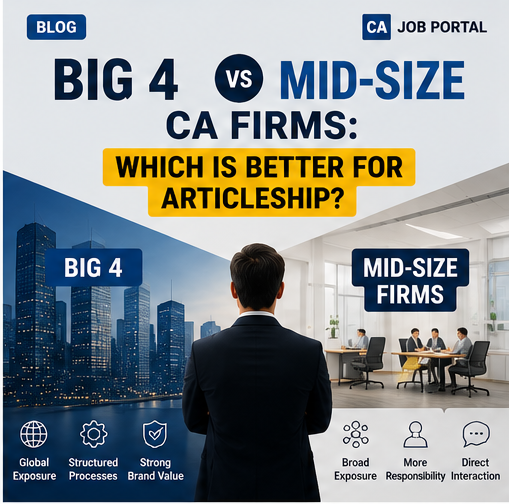
One of the most common questions CA students ask before beginning articleship is whether they should join a Big 4 firm or a mid-sized CA firm. The debate has existed for years, and there is no universal answer because both options offer unique advantages and challenges.
Many students automatically assume that securing a Big 4 articleship is the ultimate goal. While Big 4 firms certainly provide valuable opportunities, mid-sized firms can often offer learning experiences that are equally beneficial, depending on your career aspirations.
The real question is not which option is better overall. The real question is which option is better for you.
Understanding the Big 4 Firms
The term Big 4 generally refers to:
- Deloitte
- EY
- KPMG
- PwC
These firms operate globally and serve some of the world's largest companies. They are known for structured processes, specialized teams, extensive resources, and strong brand recognition.
Many CA students are attracted to the Big 4 because of the prestige associated with these organizations.
What Is Considered a Mid-Sized CA Firm?
Mid-sized firms vary significantly in size and specialization. Some may have multiple offices and hundreds of employees, while others operate with smaller teams and diverse service offerings.
Unlike Big 4 firms, mid-sized firms often provide services across multiple domains such as:
- Statutory Audit
- Tax Audit
- Direct Taxation
- GST Compliance
- Internal Audit
- ROC Compliance
- Advisory Services
This often creates broader learning opportunities for articles.
Exposure: Broad vs Specialized
This is perhaps the most important difference between the two options.
In many Big 4 firms, articles work within highly specialized teams. For example, a student may spend most of their articleship working exclusively in statutory audit or internal audit.
While this creates deep expertise in a particular area, exposure may be limited to that specific function.
In contrast, mid-sized firms frequently allow students to work across multiple domains. An article may gain exposure to audit, taxation, compliance, and client advisory work within the same training period.
Big 4 often provides depth. Mid-sized firms often provide breadth.
Client Exposure and Interaction
Client interaction is an important part of professional development.
In large organizations, communication often follows multiple reporting levels. Students may primarily interact with managers and senior team members.
Mid-sized firms often provide direct exposure to:
- Business owners
- CFOs
- Finance managers
- Partners
- Entrepreneurs
This direct interaction can significantly improve communication skills and business understanding.
Responsibility and Ownership
Articleship is most valuable when students receive meaningful responsibility.
In Big 4 firms, students typically work on larger engagements with defined roles and responsibilities.
In mid-sized firms, articles may be entrusted with greater ownership at an earlier stage, including:
- Handling assignments independently
- Preparing reports
- Communicating with clients
- Managing timelines
- Coordinating fieldwork
This responsibility often accelerates learning and confidence.
Learning Environment and Training
One major advantage of Big 4 firms is their structured training systems.
Students often benefit from:
- Formal training programs
- Learning portals
- Standardized methodologies
- Professional development initiatives
Mid-sized firms may not always offer the same level of structured training, but they often compensate through practical exposure and hands-on learning.
Work Culture and Team Size
Work culture can vary significantly between organizations.
Large firms typically operate with extensive teams and defined hierarchies.
Mid-sized firms often have smaller teams where articles work closely with managers, qualified professionals, and partners.
This can create stronger mentorship opportunities and more personalized guidance.
Career Opportunities After Qualification
Both Big 4 and mid-sized firms can open excellent career opportunities after qualification.
Big 4 experience is often highly valued by:
- Multinational corporations
- Consulting firms
- Global organizations
- Large finance teams
Mid-sized firm experience can be equally valuable because students often develop broader practical skills and exposure across multiple domains.
Recruiters increasingly focus on actual experience rather than firm names alone.
Common Myths About Big 4 Articleship
Many students believe:
- Big 4 guarantees career success.
- Mid-sized firms offer limited learning.
- Only Big 4 experience matters during interviews.
These assumptions are often inaccurate.
Successful Chartered Accountants come from both Big 4 and mid-sized firms. Long-term success depends more on learning, skill development, and professional growth than on firm branding alone.
Who Should Consider a Big 4 Firm?
A Big 4 articleship may be ideal for students who:
- Prefer structured learning environments
- Want exposure to large corporate clients
- Are interested in multinational organizations
- Plan to pursue consulting or corporate finance roles
- Value global brand recognition
Who Should Consider a Mid-Sized Firm?
A mid-sized firm may be ideal for students who:
- Want exposure across multiple domains
- Prefer broader practical learning
- Enjoy client interaction
- Want greater responsibility early in their careers
- Plan to enter practice in the future
Questions to Ask Before Deciding
Regardless of firm size, every student should ask:
- What domains will I work in?
- How much audit exposure will I receive?
- Will I work on taxation assignments?
- Will I interact with clients?
- What training opportunities are available?
- How much responsibility will I receive?
The answers to these questions are often more important than the firm's name.
Final Thoughts
The Big 4 versus mid-sized firm debate does not have a universally correct answer. Both options can provide outstanding learning opportunities when aligned with your career goals.
Instead of asking which firm is more prestigious, ask which firm will help you develop the skills, exposure, and professional confidence you need for your future career.
The best articleship is not necessarily the one with the biggest brand name—it is the one that helps you become the best Chartered Accountant you can be.